
Technical SEO Basics Every Website Owner Should Know (Complete 2026 Guide)
Building a beautiful website is only the first step toward online success. If search engines cannot properly crawl, understand, and index your website, even the best content may struggle to rank. This is where Technical SEO becomes essential.
Technical SEO focuses on optimizing the technical foundation of your website so search engines like Google can efficiently discover, crawl, index, and rank your pages. Unlike content writing or backlink building, technical SEO works behind the scenes, ensuring your website performs well from both a user experience and search engine perspective.
According to Google's latest Search Essentials and Core Update guidelines, websites that load quickly, provide excellent user experience, maintain strong security, and are easy for search engines to crawl generally perform better in search rankings.
If you're new to SEO, we recommend first reading our guide on What is SEO?, followed by our comprehensive article on On-Page SEO Checklist for Beginners. Together with this guide, you'll have a strong SEO foundation.
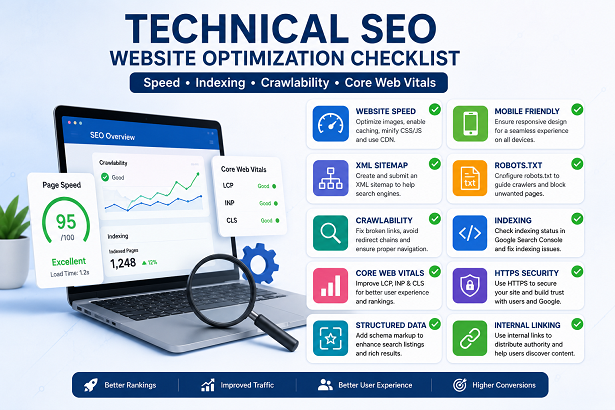
In this complete beginner-friendly guide, we'll explain every important aspect of Technical SEO in simple language so business owners, bloggers, developers, and marketers can improve website performance and achieve better Google rankings.
What is Technical SEO and Why Is It Important?
Technical SEO refers to improving the technical infrastructure of your website so search engines can crawl, index, and understand your content more efficiently.
Think of your website like a house.
- Content is the furniture.
- Design is the paint and decoration.
- Technical SEO is the foundation, plumbing, wiring, and structure.
If the foundation is weak, the entire house becomes unstable regardless of how beautiful it looks.
Similarly, your website may contain excellent articles and attractive design, but technical issues such as broken links, slow loading pages, duplicate content, or indexing errors can prevent Google from ranking it properly.
Technical SEO Helps You:
- Improve Google crawling efficiency
- Increase indexing of important pages
- Enhance Core Web Vitals performance
- Reduce crawl errors
- Improve page loading speed
- Strengthen website security with HTTPS
- Create better user experience
- Increase organic search visibility
- Support long-term SEO growth
Technical SEO works together with content marketing, on-page optimization, and quality backlinks to build a strong online presence. For businesses investing in long-term growth, combining technical improvements with our Digital Marketing Services can significantly improve visibility and lead generation.
Why Does Google Care About Technical SEO?
Google's goal is to deliver the best possible experience to users. If your website is difficult to access, loads slowly, contains broken pages, or is not optimized for mobile devices, visitors are more likely to leave quickly.
Google measures many technical quality signals before deciding how prominently a page should appear in search results. While excellent content remains critical, technical health often determines whether that content can compete effectively.
Some of the most important ranking factors influenced by Technical SEO include:
- Fast loading pages
- Mobile responsiveness
- Secure HTTPS connection
- Easy navigation
- Proper page indexing
- Internal linking structure
- No duplicate content issues
- Accessible website architecture
Businesses that invest in technical improvements usually notice better crawl efficiency, increased indexing, improved user engagement, and stronger organic performance over time.
Technical SEO is especially valuable for websites in competitive industries such as eCommerce, SaaS, professional services, education, healthcare, finance, and gaming, where search visibility can directly influence traffic and conversions.
In the next section, we'll explore the most important Technical SEO elements every website owner should implement, including website speed optimization, XML sitemaps, robots.txt, Core Web Vitals, crawlability, indexing, structured data, canonical tags, and more.
How Can You Improve Website Crawlability and Indexing?
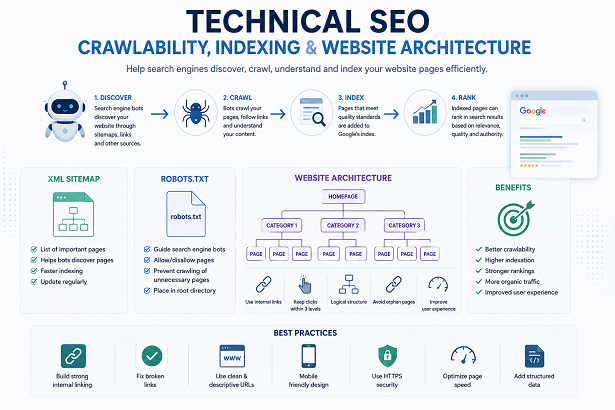
Before your pages can appear in Google Search, search engine bots must first discover, crawl, and index them. If Google's crawler cannot access important pages, those pages may never rank regardless of how valuable the content is.
Improving crawlability is one of the most important aspects of Technical SEO. A properly organized website helps search engines understand page relationships and prioritize important content.
One of the first things every website owner should do is submit an XML Sitemap in Google Search Console. A sitemap provides search engines with a roadmap of your website and informs them whenever new pages are added or existing pages are updated.
Equally important is the robots.txt file. This small file tells search engines which pages or folders should be crawled and which should remain private. However, beginners should be careful because incorrect robots.txt rules can accidentally block important pages from appearing in Google.
Another factor affecting crawlability is website architecture. Every important page should ideally be reachable within three clicks from the homepage.
- Create logical navigation menus.
- Maintain clear category structures.
- Use descriptive URLs.
- Add contextual internal links.
- Remove orphan pages.
- Fix broken links regularly.
- Avoid unnecessary redirect chains.
Our guide on What Are Backlinks and Why They Matter for SEO explains how internal and external linking together strengthen your overall SEO strategy.
Why Are Website Speed and Core Web Vitals Important?
Google has confirmed that page experience plays an important role in search rankings. Fast-loading websites not only rank better but also provide a smoother experience for visitors.
A slow website increases bounce rate, reduces conversions, and negatively affects customer satisfaction. Even a delay of one or two seconds can significantly reduce user engagement.
Google measures website performance using Core Web Vitals.
- Largest Contentful Paint (LCP) measures loading performance.
- Interaction to Next Paint (INP) measures responsiveness.
- Cumulative Layout Shift (CLS) measures visual stability.
Improving these metrics enhances both SEO and user experience.
Ways to Improve Website Speed
- Compress large images.
- Use next-generation image formats like WebP.
- Enable browser caching.
- Minify CSS and JavaScript files.
- Reduce unnecessary plugins.
- Use a Content Delivery Network (CDN).
- Choose reliable web hosting.
- Implement lazy loading for images.
- Optimize server response time.
- Remove unused CSS and JavaScript.
If you're planning a website redesign, implementing these performance improvements from the beginning is much easier than fixing them later. Learn more in our guide on Static vs Dynamic Website – Which is Better for Your Business.
What Role Do HTTPS, Structured Data, and Canonical Tags Play?
Technical SEO extends beyond speed and indexing. Search engines also evaluate how secure, organized, and understandable your website is.
HTTPS Security
HTTPS encrypts communication between users and your website, protecting sensitive information. Google has used HTTPS as a ranking signal for years, and modern browsers label non-secure websites as "Not Secure," which can reduce visitor trust.
Structured Data (Schema Markup)
Structured data helps search engines understand your content more accurately. By implementing Schema.org markup, you can qualify for rich search results such as FAQs, breadcrumbs, reviews, articles, products, and organization information.
For example, all of the blogs on Dhvanii Web Consultants include:
- Article Schema
- FAQ Schema
- Organization Schema
- Breadcrumb Schema
- Author Schema
These structured data types improve content understanding and may increase click-through rates in search results.
Canonical Tags
Canonical tags tell Google which version of a page should be treated as the primary version when similar or duplicate pages exist. This prevents duplicate content issues and consolidates ranking signals.
For example, if both HTTP and HTTPS versions of a page exist, the canonical tag should point to the preferred HTTPS version.
In the next section, we'll cover advanced Technical SEO topics, including mobile-first indexing, crawl error monitoring, common technical SEO mistakes, a complete beginner checklist, FAQs, and expert recommendations for maintaining long-term website health.
How Does Mobile-First Indexing Affect Technical SEO?
Today, most users browse websites using smartphones rather than desktop computers. Because of this shift in user behavior, Google now uses mobile-first indexing. This means Google primarily evaluates the mobile version of your website when determining search rankings.
If your website performs well on desktop but offers a poor mobile experience, your rankings may suffer. Every website owner should therefore ensure that their website is fully responsive, easy to navigate, and optimized for smaller screens.
A mobile-friendly website should include:
- Responsive layouts that automatically adjust to different screen sizes.
- Readable font sizes without zooming.
- Buttons that are easy to tap.
- Fast-loading mobile pages.
- Proper spacing between clickable elements.
- Optimized images and videos.
- No horizontal scrolling.
- Simple and intuitive navigation.
If your website is outdated, consider upgrading it through our Website Redesigning Services to improve usability and search performance.
What Are the Most Common Technical SEO Mistakes?
Many websites unknowingly make technical mistakes that prevent them from achieving their full ranking potential. Fortunately, most of these problems can be identified and fixed with regular SEO audits.
Common Technical SEO Errors
- Slow page loading speed.
- Broken internal or external links.
- Missing XML sitemap.
- Incorrect robots.txt configuration.
- Duplicate content without canonical tags.
- Large uncompressed images.
- Missing HTTPS security.
- Poor mobile responsiveness.
- Redirect loops and redirect chains.
- 404 error pages without proper handling.
- Missing structured data.
- Poor URL structure.
- Orphan pages with no internal links.
- Thin or outdated content.
- Server downtime and hosting issues.
Regularly reviewing your website in Google Search Console helps detect many of these issues before they negatively affect your rankings.
Technical SEO Checklist Every Website Owner Should Follow
The following checklist summarizes the most important technical SEO tasks that every business website should complete.
Following this checklist provides a strong technical foundation for long-term SEO success. When combined with high-quality content, effective on-page optimization, and authoritative backlinks, these improvements significantly increase your website's chances of ranking higher in Google Search.
Final Thoughts
Technical SEO is often overlooked because many improvements happen behind the scenes. However, it forms the backbone of every successful SEO strategy.
Without a technically healthy website, even exceptional content and high-quality backlinks may not achieve their full ranking potential.
Investing time in improving crawlability, indexing, website speed, security, structured data, mobile usability, and Core Web Vitals creates a better experience for both search engines and users.
As Google's algorithms continue evolving, websites that prioritize technical excellence, user experience, and helpful content will continue to outperform competitors over the long term.
In the final section, we'll cover frequently asked questions, author information, trusted references, and the blog conclusion.
Frequently Asked Questions
1. What is Technical SEO?
Technical SEO is the process of optimizing a website's technical foundation so search engines can crawl, index, and rank pages more effectively. It includes improving website speed, mobile responsiveness, XML sitemaps, structured data, HTTPS security, Core Web Vitals, and overall website architecture.
2. Is Technical SEO different from On-Page SEO?
Yes. Technical SEO focuses on the website's infrastructure, while On-Page SEO optimizes content, headings, keywords, internal links, and meta tags. Both work together to improve search engine visibility.
3. Why is website speed important for SEO?
Fast-loading websites provide a better user experience, reduce bounce rates, improve Core Web Vitals, and support higher Google rankings. Website speed is one of the most important technical ranking factors.
4. What are Core Web Vitals?
Core Web Vitals are Google's performance metrics that measure page loading speed, responsiveness, and visual stability. Optimizing these metrics improves both user experience and SEO performance.
5. What is an XML Sitemap?
An XML Sitemap is a file that lists important pages on your website, helping search engines discover and crawl them more efficiently.
6. Why is HTTPS important?
HTTPS encrypts communication between users and your website, improving security, building trust, and acting as a Google ranking signal.
7. How often should Technical SEO be audited?
Every website should undergo a technical SEO audit at least every three to six months. Regular audits help identify crawl errors, broken links, indexing issues, performance problems, and other technical concerns before they impact rankings.
If you want expert help, check our digital marketing services.
Related Articles
- What is SEO? Complete Beginner's Guide
- On-Page SEO Checklist for Beginners
- Top 10 SEO Strategies That Actually Work in 2026
- What Are Backlinks and Why They Matter for SEO
Sources & References
- Google Search Central Documentation
- Google SEO Starter Guide
- Google PageSpeed Insights
- Google Web.dev – Core Web Vitals
Conclusion
Technical SEO is the foundation of every successful website. While quality content and backlinks remain essential, they can only deliver maximum results when your website is technically sound. Fast loading pages, mobile responsiveness, secure HTTPS connections, proper indexing, structured data, optimized site architecture, and strong Core Web Vitals all contribute to better search visibility and user satisfaction.
By regularly auditing your website and following the best practices outlined in this guide, you can build a technically optimized website that performs well in Google's search results and provides an outstanding experience for visitors. As Google's algorithms continue evolving, investing in Technical SEO remains one of the smartest long-term strategies for sustainable organic growth.