
On-Page SEO Checklist for Beginners (Complete Guide)
On-page SEO remains one of the most important foundations of search engine optimization. Whether you run a business website, gaming platform, eCommerce store, blog, educational portal, or service company, proper on-page SEO helps search engines understand your content and improves your chances of ranking higher in search results.
Google's recent Core Updates and Helpful Content updates place greater emphasis on content quality, user experience, expertise, authority, and trustworthiness (EEAT). This means businesses can no longer rely on keyword stuffing or outdated SEO tricks. Instead, websites must provide genuine value while maintaining strong technical and content optimization.
In this complete beginner-friendly guide, you'll learn the essential on-page SEO checklist that can help improve rankings, increase organic traffic, and enhance user experience in 2026 and beyond.
If you're new to SEO, you may also find our guide on What Is SEO and How It Works for Small Businesses useful before diving deeper into optimization techniques.
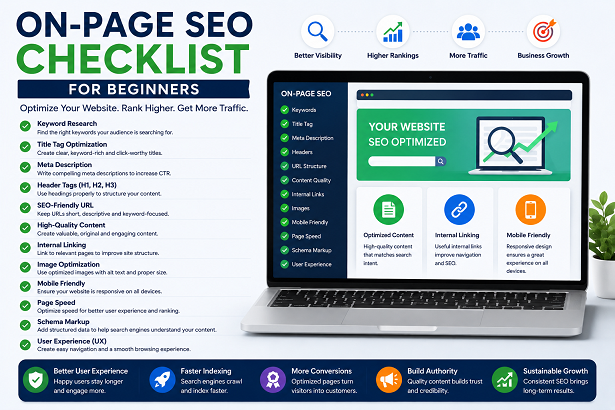
What Is On-Page SEO and Why Is It Important?
On-page SEO refers to all optimization activities performed directly on your website pages to improve visibility in search engines.
Unlike off-page SEO, which focuses on backlinks and external signals, on-page SEO helps search engines understand:
- What your page is about
- Which keywords it targets
- How valuable the content is
- How users interact with the page
- Whether the page satisfies search intent
Proper on-page optimization improves:
- Organic rankings
- Website traffic
- User engagement
- Conversion rates
- Content discoverability
- Website authority
How Do You Choose the Right Keywords?
Keyword research is the starting point of every successful SEO strategy.
Before creating content, identify what your target audience is searching for.
Good keyword research should focus on:
- Search volume
- User intent
- Competition level
- Business relevance
- Long-tail opportunities
For example, instead of targeting a broad keyword like:
SEO
You could target:
- On-page SEO checklist for beginners
- SEO guide for small businesses
- How to optimize website pages
- SEO tips for gaming websites
Long-tail keywords often convert better because they match specific user intent.
Why Are Title Tags Important?
Your title tag is one of the strongest on-page SEO signals.
Google uses the title tag to understand page content and display it in search results.
Best practices include:
- Include primary keyword naturally
- Keep length between 50–60 characters
- Make titles compelling
- Avoid keyword stuffing
- Use unique titles for every page
Example:
On-Page SEO Checklist for Beginners (Complete Guide 2026)
This title clearly communicates the topic while encouraging clicks.
How Should You Optimize Meta Descriptions?
Meta descriptions don't directly impact rankings, but they influence click-through rates.
A strong meta description should:
- Summarize page content
- Include primary keywords naturally
- Remain under 160 characters
- Encourage users to click
Example:
Learn the complete on-page SEO checklist for beginners and improve rankings, traffic, and user experience with proven optimization techniques.
How Should Headings Be Structured?
Headings help organize content for both users and search engines.
Every page should have:
- One H1 heading
- Multiple H2 headings
- Optional H3 and H4 subheadings
Proper heading hierarchy improves readability and helps search engines understand content relationships.
Why Does Content Quality Matter More Than Ever?
Google's Helpful Content System focuses heavily on content quality.
Content should:
- Answer user questions
- Demonstrate expertise
- Provide original insights
- Be accurate and trustworthy
- Offer practical value
Thin content rarely performs well after recent Google updates.
Instead, create comprehensive pages that fully address the topic.
Businesses can also improve content authority by connecting related resources, such as our guide on Top 10 SEO Strategies That Actually Work in 2026.
How Important Are Internal Links?
Internal linking is one of the most overlooked SEO opportunities.
Internal links help:
- Distribute page authority
- Improve crawling
- Increase page views
- Guide users through your website
- Strengthen topical relevance
For example, this article can connect naturally to:
These connections help search engines understand your expertise across related topics.
How Should URLs Be Optimized?
URLs should be clean, descriptive, and easy to understand.
Good example:
yourwebsite.com/on-page-seo-checklist
Poor example:
yourwebsite.com/page?id=4567xyz
SEO-friendly URLs should:
- Include primary keywords
- Be short and descriptive
- Avoid unnecessary parameters
- Use hyphens between words
Why Are Images Important for SEO?
Images improve engagement and help explain concepts visually.
However, many websites forget image optimization.
Best practices include:
- Use descriptive filenames
- Add relevant ALT text
- Compress images
- Use WebP format when possible
- Maintain responsive sizing
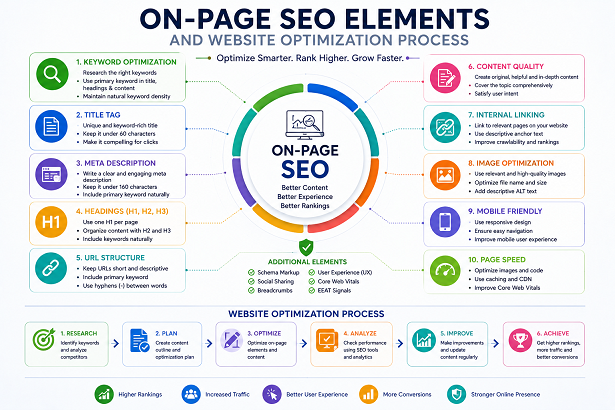
Image optimization also improves page speed and accessibility.
How Important Is Mobile SEO in 2026?
Mobile SEO is no longer optional. Google uses mobile-first indexing, meaning it primarily evaluates the mobile version of your website when determining rankings.
A mobile-friendly website should:
- Load quickly on smartphones
- Use responsive design
- Have readable text without zooming
- Provide easy navigation
- Offer touch-friendly buttons
- Avoid intrusive popups
Businesses that ignore mobile optimization often experience lower rankings, reduced engagement, and lost conversions.
If you're planning a new website, you may also find our article Why Your Business Needs a Professional Website in 2026 helpful.
What Are Core Web Vitals and Why Do They Matter?
Core Web Vitals are Google's user experience metrics that evaluate page performance.
The three main metrics include:
- LCP (Largest Contentful Paint) – Measures loading speed
- INP (Interaction to Next Paint) – Measures responsiveness
- CLS (Cumulative Layout Shift) – Measures visual stability
Improving Core Web Vitals helps:
- Enhance user experience
- Reduce bounce rates
- Improve engagement
- Support higher rankings
How Can EEAT Improve Rankings?
Google increasingly evaluates content through the EEAT framework:
- Experience
- Expertise
- Authoritativeness
- Trustworthiness
To strengthen EEAT:
- Publish expert-written content
- Show author information
- Provide accurate information
- Include references when relevant
- Maintain transparent business details
- Update content regularly
Businesses operating in competitive industries such as digital marketing, gaming, healthcare, finance, and technology benefit significantly from stronger EEAT signals.
Why Is Schema Markup Important?
Schema markup helps search engines understand content more effectively.
Structured data can improve:
- Rich snippets
- FAQ results
- Breadcrumb visibility
- Article understanding
- Knowledge Graph eligibility
Popular schema types include:
- Article Schema
- FAQ Schema
- Organization Schema
- Breadcrumb Schema
- Review Schema
- Product Schema
Google provides detailed guidance on structured data through Google Search Central.
What Common On-Page SEO Mistakes Should Beginners Avoid?
Many websites fail to rank because of avoidable optimization mistakes.
Common errors include:
- Keyword stuffing
- Duplicate content
- Missing title tags
- Poor heading structure
- Broken internal links
- Unoptimized images
- Slow page speed
- Thin content
- Ignoring mobile users
- Lack of schema markup
Avoiding these issues can significantly improve SEO performance.
Complete On-Page SEO Checklist for Beginners
Conclusion
On-page SEO remains one of the most effective ways to improve search visibility and organic traffic. While search engine algorithms continue to evolve, the core principle remains the same: create valuable content and deliver an exceptional user experience.
Beginners should focus on:
- Keyword optimization
- Content quality
- Title tags and meta descriptions
- Internal linking
- Mobile responsiveness
- Page speed
- Schema markup
- EEAT principles
Businesses that consistently follow these best practices are more likely to achieve sustainable rankings and long-term growth in Google search results.
Frequently Asked Questions (FAQs)
What is on-page SEO?
On-page SEO refers to optimizing individual website pages to improve search engine rankings and user experience.
How many keywords should I target on one page?
Most pages should focus on one primary keyword and several closely related secondary keywords.
Does on-page SEO still matter in 2026?
Yes. On-page SEO remains one of Google's most important ranking factors because it helps search engines understand content relevance and quality.
What is the most important on-page SEO factor?
High-quality content that satisfies user intent is often considered the most important on-page SEO factor.
How often should I update website content?
Review important pages regularly and update them whenever information changes or becomes outdated.
If you want expert help, check our digital marketing services.
Sources & References
- Google Search Central Documentation
- Google Helpful Content Guidelines
- Google Core Web Vitals Documentation
- Google Structured Data Documentation
- Google EEAT Best Practices
This guide is intended for educational purposes and follows Google's EEAT principles, Helpful Content guidelines, and modern SEO best practices.