
What Are Backlinks and Why They Matter for SEO
Backlinks remain one of the most important ranking factors in search engine optimization (SEO). Even with Google's continuous algorithm updates, artificial intelligence integration, and EEAT-focused ranking systems, quality backlinks continue to play a crucial role in determining website authority and search visibility.
If you've ever wondered why some websites consistently rank higher on Google while others struggle to gain visibility, backlinks are often one of the key reasons. Search engines view backlinks as votes of confidence. When reputable websites link to your content, Google interprets this as a signal that your website provides valuable and trustworthy information.
However, not all backlinks are equal. Modern SEO is no longer about collecting thousands of random links. Today's successful SEO strategies focus on earning high-quality, relevant, and authoritative backlinks that genuinely improve user experience and content credibility.
In this complete beginner-friendly guide, we'll explain what backlinks are, why they matter, how they affect rankings, and the best practices for building backlinks in 2026 without violating Google's guidelines.
If you're new to SEO, you may also want to read our guide on What Is SEO and How It Works for Small Businesses before diving deeper into backlink strategies.
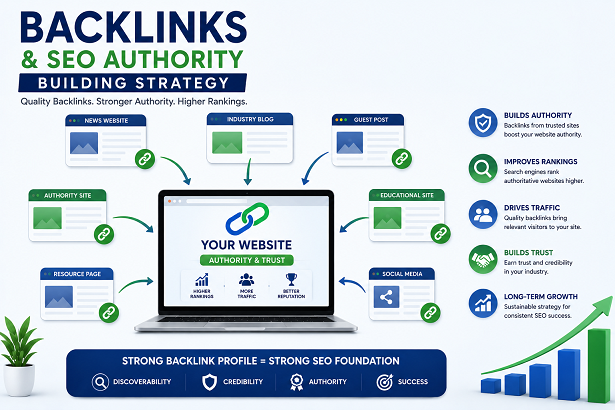
What Are Backlinks in SEO?
A backlink is a hyperlink from one website to another website.
For example, if a technology blog links to your business website, that link is considered a backlink.
Backlinks are also known as:
- Inbound links
- Incoming links
- External links
- Link building references
Search engines use backlinks to discover new content and evaluate the authority of web pages.
Think of backlinks as recommendations. When trusted websites link to your content, they are essentially telling Google that your page is useful and credible.
Why Do Backlinks Matter for SEO?
Backlinks help search engines evaluate website authority and trustworthiness.
Google's ranking systems analyze backlink profiles to determine:
- Website authority
- Industry relevance
- Trustworthiness
- Popularity
- Content quality signals
When authoritative websites consistently link to your content, your website becomes more likely to rank for competitive keywords.
Backlinks help improve:
- Search rankings
- Organic traffic
- Brand visibility
- Domain authority
- Referral traffic
- Trust signals
Google's ranking systems continue to use links as an important signal alongside content quality, user experience, EEAT, and technical SEO.
How Does Google Evaluate Backlinks?
Many beginners assume that more backlinks automatically lead to higher rankings.
That is no longer true.
Modern SEO focuses on backlink quality rather than quantity.
Google evaluates backlinks based on several factors:
- Authority of linking website
- Topical relevance
- Anchor text usage
- Link placement
- User value
- Natural acquisition patterns
A single backlink from an authoritative industry website can often provide more SEO value than hundreds of low-quality backlinks.
What Types of Backlinks Exist?
Understanding backlink types helps businesses build healthier link profiles.
1. Editorial Backlinks
Editorial backlinks occur naturally when websites reference valuable content.
These are often considered the most valuable backlinks because they are earned rather than created.
2. Guest Post Backlinks
Guest posting involves writing content for another website and earning a backlink in return.
When done properly on relevant websites, guest posting remains an effective strategy.
3. Business Directory Backlinks
Business directories can provide useful citations and backlinks, especially for local SEO.
Examples include:
- Google Business Profile
- Industry directories
- Local business listings
- Professional associations
4. Resource Page Backlinks
Many websites maintain resource pages that link to valuable content and tools.
Getting featured on these pages can generate quality backlinks and referral traffic.
5. Social Mentions and Brand References
Although most social media links are nofollow, strong brand visibility can indirectly contribute to link acquisition.
What Is the Difference Between Dofollow and Nofollow Links?
Backlinks can be categorized as dofollow or nofollow.
Do follow links pass authority signals to the linked page.
No follow links tell search engines not to pass ranking authority directly.
A natural backlink profile contains both dofollow and nofollow links.
Can Backlinks Improve Local SEO Rankings?
Yes.
Backlinks play an important role in local SEO as well.
Businesses targeting local customers can benefit from:
- Local directory links
- Regional business listings
- Local news websites
- Community organizations
- Industry associations
For local businesses, backlinks work alongside local citations, reviews, and Google Business Profile optimization.
You can learn more in our guide: How to Rank Your Business in Local Search.
How Do Backlinks Support Google's EEAT Principles?
Google increasingly emphasizes Experience, Expertise, Authoritativeness, and Trustworthiness (EEAT).
Quality backlinks help reinforce these signals because reputable websites generally link only to trustworthy and valuable content.
Backlinks contribute to:
- Authority recognition
- Industry credibility
- Brand trust
- Content validation
- Expert positioning
This is particularly important for business websites, educational websites, technology portals, gaming platforms, and professional service providers.
As Google continues prioritizing EEAT, backlinks remain one of the strongest authority indicators available.
Should Businesses Focus on Content Before Building Backlinks?
Absolutely.
One of the biggest mistakes beginners make is trying to build backlinks before creating valuable content.
The best backlink strategy begins with content worth linking to.
Examples include:
- Industry guides
- Research studies
- Case studies
- Original insights
- Educational resources
- Tools and calculators
Google's Helpful Content System rewards websites that genuinely help users.
Without strong content, backlink acquisition becomes significantly more difficult.
For additional SEO strategies, explore our guide on Top 10 SEO Strategies That Actually Work in 2026.
What Are the Best Ways to Build Backlinks in 2026?
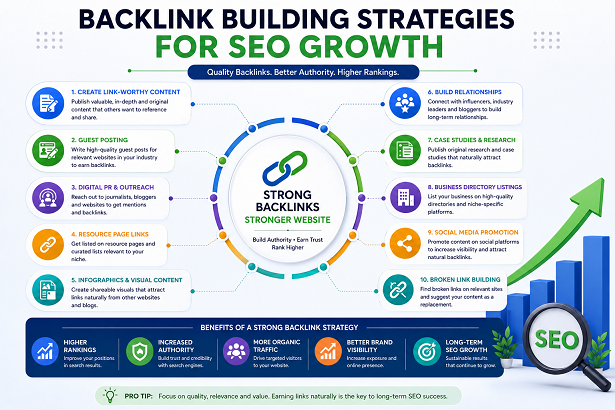
The most successful backlink strategies today focus on creating value rather than manipulating search engines. Google's algorithms are increasingly effective at identifying unnatural link-building practices, making quality more important than ever.
Here are some of the most effective white-hat backlink-building strategies:
- Create comprehensive industry guides
- Publish original research and statistics
- Write guest posts on authoritative websites
- Earn mentions from industry publications
- Build relationships with influencers
- Get featured in resource pages
- Create shareable infographics
- Develop useful online tools and calculators
- Participate in expert roundups
- Publish case studies and success stories
Businesses that consistently create useful content often attract backlinks naturally over time.
What Backlink Practices Should You Avoid?
Not all backlinks help SEO. Some backlink practices can actually harm rankings and result in algorithmic penalties.
Avoid these black-hat SEO techniques:
- Buying backlinks from link farms
- Private Blog Networks (PBNs)
- Automated backlink software
- Spam blog comments
- Forum profile spam
- Mass directory submissions
- Hidden links
- Irrelevant guest posting networks
Google's SpamBrain system continuously improves its ability to detect manipulative link-building tactics. Building backlinks naturally is always the safest long-term strategy.
How Many Backlinks Does a Website Need?
There is no fixed number of backlinks required to rank on Google.
The number depends on:
- Competition level
- Industry niche
- Keyword difficulty
- Content quality
- Website authority
- User experience signals
For some low-competition keywords, a few high-quality backlinks may be enough. For highly competitive industries, ranking may require hundreds or thousands of authoritative links accumulated over time.
Instead of focusing on quantity, businesses should focus on building a diverse and trustworthy backlink profile.
How Do Backlinks Work Together with On-Page SEO?
Backlinks alone cannot guarantee rankings.
Successful SEO requires both strong on-page optimization and quality backlinks.
Even the strongest backlink profile may struggle to rank if a website has:
- Poor content quality
- Slow loading speed
- Weak keyword optimization
- Bad user experience
- Poor mobile responsiveness
Similarly, excellent content may struggle to rank if it lacks authority signals from backlinks.
This is why SEO should be viewed as a complete system where content, technical SEO, user experience, and backlinks work together.
You can also read our guide: On-Page SEO Checklist for Beginners for a deeper understanding of content optimization.
Do Backlinks Still Matter After Google's AI Updates?
Yes.
Many website owners wonder whether backlinks are becoming less important because of AI-powered search experiences and evolving ranking systems.
While Google's algorithms continue evolving, backlinks remain one of the strongest signals of authority and trust.
AI systems help Google better understand content quality, but backlinks still provide valuable evidence that other websites trust and recommend your content.
In fact, as AI-generated content becomes more common, authority signals like backlinks may become even more important for distinguishing trustworthy sources.
Backlink Building Checklist for Beginners
Use this checklist to build a healthy backlink profile:
- Create original and helpful content
- Optimize content for user intent
- Earn links from relevant websites
- Focus on quality over quantity
- Monitor backlink profile regularly
- Avoid spammy link schemes
- Build relationships in your industry
- Publish research and case studies
- Improve website user experience
- Maintain a natural anchor text profile
Conclusion
Backlinks remain one of the most influential ranking factors in SEO. While Google's algorithms have become significantly more advanced, backlinks continue to serve as valuable trust and authority signals.
The key to successful backlink building in 2026 is focusing on quality, relevance, and user value. Businesses that invest in helpful content, strong relationships, and ethical SEO practices are far more likely to earn backlinks that support long-term growth.
Instead of chasing shortcuts, focus on becoming a trusted resource within your industry. When your content genuinely helps users, backlinks often follow naturally.
For businesses seeking sustainable SEO growth, backlinks should be part of a broader strategy that includes technical SEO, on-page optimization, content marketing, local SEO, and user experience improvements.
Frequently Asked Questions (FAQ)
What is a backlink in SEO?
A backlink is a hyperlink from one website to another website. Search engines use backlinks to evaluate authority, trust, and relevance.
Are backlinks still important for SEO in 2026?
Yes. Backlinks remain one of the most important ranking signals and continue to influence search visibility and website authority.
How can I get backlinks naturally?
Create valuable content, publish research, write guest posts, earn industry mentions, and build relationships with relevant websites.
Can bad backlinks hurt SEO?
Yes. Spammy, irrelevant, or manipulative backlinks can negatively impact SEO performance and may trigger Google spam detection systems.
How long does it take for backlinks to improve rankings?
Results vary depending on competition, website authority, and backlink quality. Improvements can take weeks or several months.
What is the difference between dofollow and nofollow links?
Dofollow links pass authority signals, while nofollow links generally do not directly transfer ranking value, although they can still provide referral traffic and visibility.
If you want expert help, check our digital marketing services.